


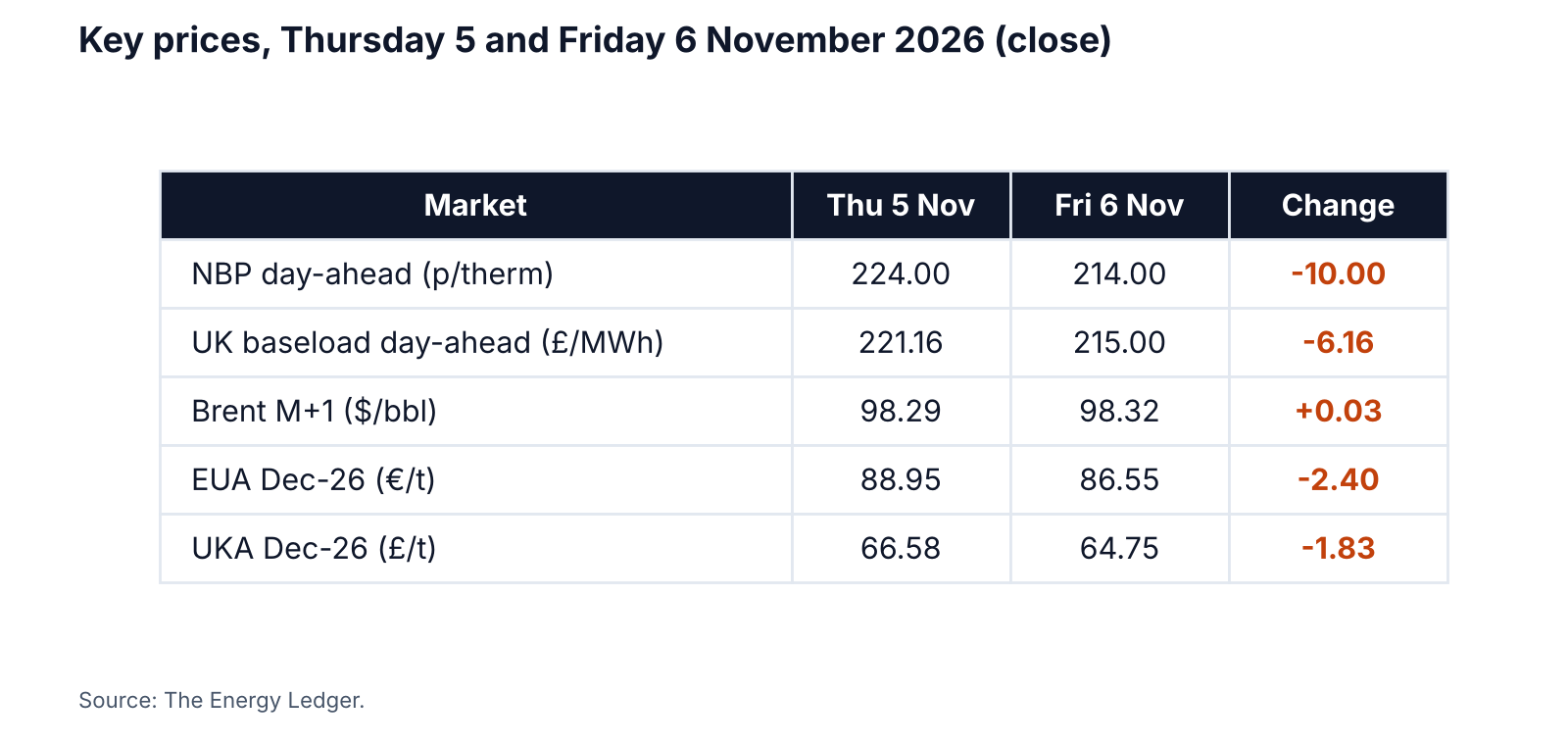
UK gas ended last week lower, with NBP day-ahead closing on Friday 6 November at 214.00 p/therm, down 10.00 on the day, after a 12.00 rise to 224.00 on Thursday. December 2026 closed at 212.25 p/therm, down 12.67. On Monday morning NBP was indicated at about 217 to 218.50 p/therm, up roughly 2%, as weekend reports of ships hit near the Strait of Hormuz revived supply worries. GB day-ahead baseload power closed Friday at £215.00/MWh, down £6.16, and was offered around £245/MWh on Monday. Brent closed at $98.32/bbl after a fall of about 13% on the week, its steepest since March 2020.
Why prices fell, and why they did not stay down
The slide followed the US midterm elections on 3 November, which gave the Democrats control of both chambers of Congress. Traders read that as improving the odds of a diplomatic settlement with Iran, and the war premium came out of oil and gas. Brent fell 7.6% on Monday 2 November to about $105 and about 9% on Wednesday to $94.62. European gas dropped more than 15% on the week.
The physical risks have not gone. On Thursday, Brent rebounded 3.9% after Iran reported three more tanker attacks, and mines have reportedly struck vessels near Hormuz. On Sunday 8 November, the US president said a new strike on Iran was highly unlikely while talks continue. Brent eased 1.5% to $96.91 on Monday morning, with analysts looking for support near $93, and Dutch TTF front-month was up 1.4% at €86.70/MWh.
Norway, storage and LNG
A fire on the Visund platform on 4 November has taken 13.2 mcm/day of Norwegian export capacity offline, about 3.7% of the total. The outage is scheduled to run to at least 16 November and may be revised. No injuries were reported and all 128 people on board were accounted for. The 13.2 mcm/day figure is maximum capacity, not confirmed pre-fire output, and Norway’s offshore safety regulator has opened an investigation with no published timetable. Oseberg lost 6.3 mcm/day intraday on Thursday and returned on Friday.
Norwegian exit nominations were 336.6 mcm/day on Monday, with about 116 mcm/day heading to the UK. UK continental shelf output was 111.50 mcm/day, up from 106.60 on Thursday. About 95% of Norwegian exports move through fixed subsea pipelines, so there is little scope to reroute volumes.
European storage is about 74% full against a five-year average near 90%, and withdrawals have started. Qatar’s LNG force majeure runs to at least the end of December, taking nearly a fifth of global LNG supply off the market. UK LNG send-out fell to 54 mcm/day on Monday from 70 on Friday, and UK system demand rose 10.54 mcm/day to 262.02 mcm/day on a colder forecast. The fire alone is not a supply crisis. The risk is a delayed restart landing in colder weather with storage already low.
Power, wind and carbon
Wind’s share of generation fell from about 29.7% to 28.1% on Thursday, with gas at 42.7%. Better wind on Friday pulled prices down, but by Monday it had faded. In the half hour from 11:30 on 9 November, NESO carbon intensity data showed gas at 57.7% of generation, nuclear 13.0%, solar 11.6% and wind 3.0%. Intensity was 264 gCO2/kWh in the half hour from 16:30, rated very high. Intraday prices on Monday ran from £102.10/MWh overnight to £339/MWh in the 06:30 to 08:00 ramp.
About 1,076 MW of UK nuclear capacity is affected across Heysham 1, Heysham 2 and Torness 2, with units due off from 27 November. French nuclear output was reported 2.4 GW lower late last week because of strike action.
December 2026 baseload closed Friday at £174.00/MWh, Q1 2027 at £172.95 and Summer 2027 at £123.05. EUA December 2026 fell €2.40 to €86.55/t and UKA December 2026 fell £1.83 to £64.75/t, leaving UKA at a discount to EUA of just under €9/t.
What this means for buyers
A 10p move in a day is large enough to change a fixed-price quote materially between morning and afternoon. Buyers renewing this winter may want to check how long quotes are held and whether tranche or flexible purchasing is on offer. The recent fall came from politics, not from any easing in physical supply, so the downside is not guaranteed to hold.
Power prices are following gas and wind closely, so wind forecasts matter for day-ahead and within-day exposure. The forward curve sits well below spot, with Q1 2027 about £42/MWh under Friday’s day-ahead price. Buyers fixing winter volumes may want to look at how much of their unit rate is exposed to spot and balancing costs in low-wind periods, and to compare quotes at different times of day, since Norwegian maintenance messages can move prompt prices sharply.
What to watch
This week: whether US-Iran talks, mediated through Qatar, hold and whether Hormuz attacks continue.
Monday 16 November: scheduled end of the Visund outage, which may be revised.
Daily: wind forecasts, Norwegian maintenance messages and UK LNG send-out.
Weekly: pace of European storage withdrawals against the five-year average.
Friday 27 November: UK nuclear units due off at Heysham and Torness.
End of December: end of the Qatari LNG force majeure, if not extended.