


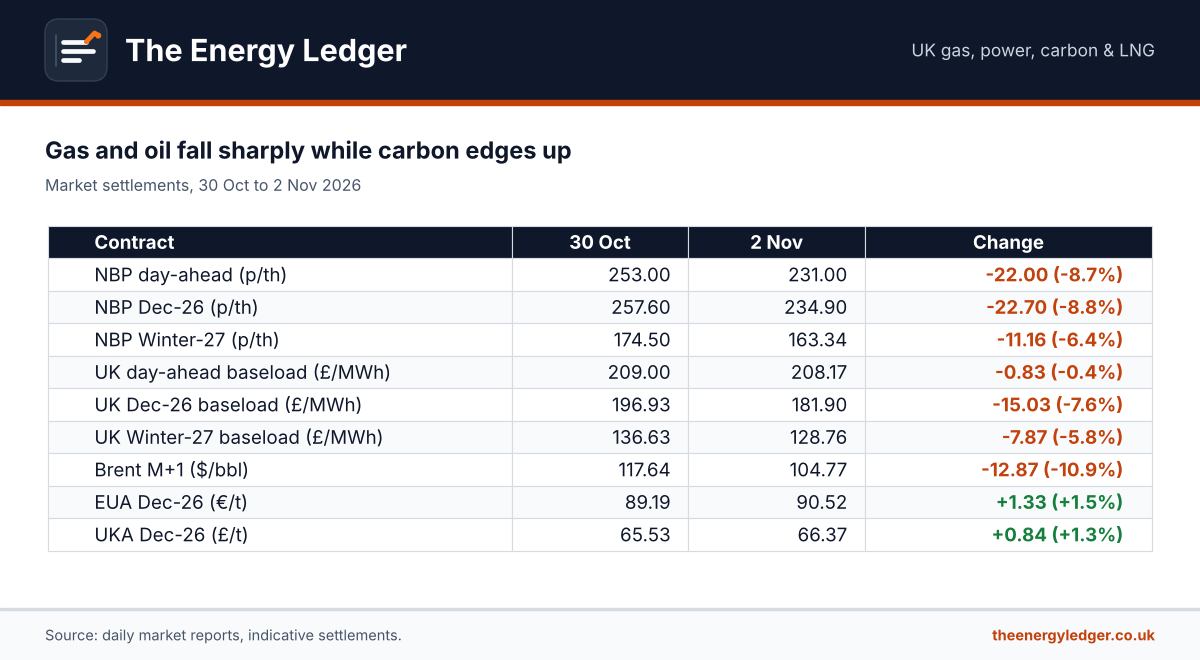
The week opened with a relief rally in reverse. On Monday 2 November the UK gas curve fell hard as reports of US-Iran diplomacy hit a market that had been trading near four-year highs. NBP day-ahead settled at 231.00p/th, down 22.00p/th (8.7%) from Friday’s 253.00p/th. The December contract settled 22.70p/th lower, a fall of 8.8%. Brent fell $12.87 to $104.77 a barrel.
The trigger was a run of headlines. Iranian delegates were reported leaving Doha after talks with Qatari negotiators, and Foreign Minister Araghchi proposed cutting the planned seven-day reopening period for the Strait of Hormuz to two days. A report from Iran’s state news agency that the Supreme Leader had given the government authority to negotiate added to the move. European gas futures fell more than 10% at one point.
By Tuesday the picture had turned again. Front-month NBP was quoted at 245.6p/th, up 10.7p/th (4.5%) on Monday’s settlement, after fresh US strikes on Iran’s Qeshm Island. The indicative day-ahead price was 241.50p/th at 09:27. Market commentary is consistent: diplomacy is moving, but Iran’s demands and Washington’s have not converged, and Gulf states have been told to prepare for renewed strikes. Today’s US midterm elections are the next marker, since several sources expect any decision on renewed action to come after the vote.
Gas: the premium is still there
Even after Monday, the curve sits well above where it was a week ago, and the backwardation has barely changed. Summer-27 settled at 171.07p/th on Monday, still above Winter-27 at 163.34p/th. The front end is still pricing a tight winter. European storage is 74.6% full, and Germany sits at 61% against a 70% target.
Norway is the other thing to watch. Oseberg and Asgard capacity was cut by 27.2 mcm/d, with Oseberg expected back by 5 November, though the duration of the outage is uncertain. Total Norwegian nominations were 323.1 mcm/d on Monday.
Power: gas fell the day-ahead did not
The day-ahead power price barely moved. Baseload rose about 1.6% on the day to £210.00/MWh on below-average temperatures and lower renewable output, while the December contract fell 7.6%. December baseload now sits below the fuel and carbon cost of gas-fired generation, which implies negative margins for gas plants at that price. Clean spark spreads for 30 October were already negative from November onwards (-£7.77/MWh for November), so the gap was there before Monday.
Wind is the near-term swing factor. UK wind is expected to halve from roughly 8GW to 4GW later this week, and output was 7.5GW (21%) on Tuesday morning against 9.6GW (27%) on Monday.
[Chart 2: energy-ledger-2026-11-03-A-chart-2.png]
Alt text: Bar chart of Brent front-month settlements from 28 October to 2 November, with a drop to $104.77 per barrel on 2 November.
Oil and carbon
Brent’s fall was the largest in the complex. Quotes differ on level: $109.7 on Monday morning and $105.7 in the evening, against a settlement of $104.77. Carbon held firm, with EUA Dec-26 up €1.33 to €90.52 and UKAs rising further on Tuesday.
What this means for buyers
Monday showed how little of the move is about physical supply. UK system demand is forecast at 214 to 239 mcm/d this week, the system opened around 5 mcm/d long on Tuesday, and LNG send-out has recovered. The price swing came from headlines. For buyers with open positions, a day like this creates a window, but one that can close on the next headline.
What to watch
The US midterm outcome and any signal on renewed strikes on Iran.
Whether Iran and Washington narrow the gap on the Strait of Hormuz re-opening terms.
Oseberg’s return, expected by 5 November, and the Nyhamna curtailment.
UK wind falling to about 4GW later this week, with forecasts showing a recovery from 10 November.
The IEA’s Global Gas Security Review and Q4 Gas Market Report, due today.
The Energy Ledger
This newsletter is for information only and does not constitute financial or procurement advice.