


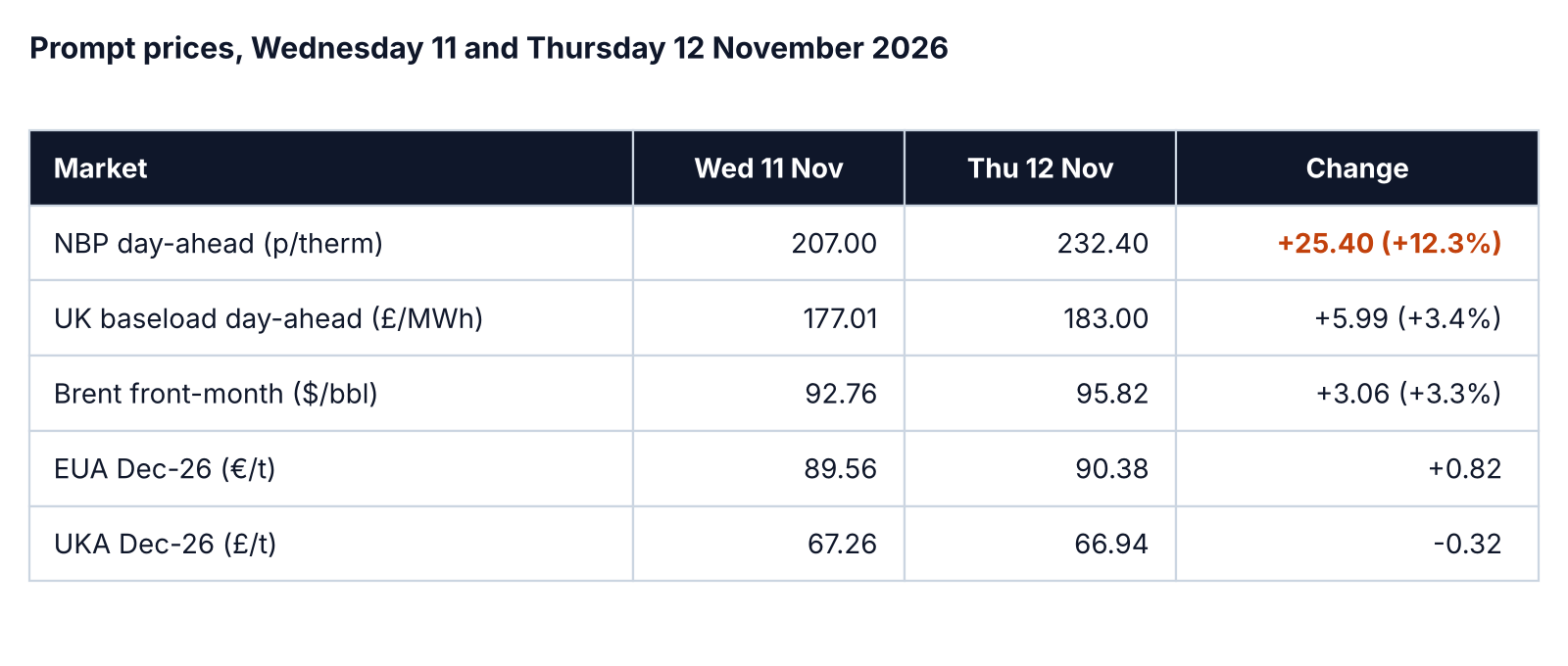
EU gas storage was 71.25% full on 12 November, about 11 percentage points below last year and 18 below the five-year average. Withdrawals between 26 October and 9 November ran at close to ten times last year’s pace, and the gap to last year’s level widened from 7.9 to 10.5 points over that spell. NBP day-ahead settled at 232.40p/therm on Thursday and TTF December at €92.26/MWh.
The combination matters more than either part alone. Europe started the winter with less gas in the ground than it would like, and a run of supply losses in Norway has arrived just as colder weather lifts demand. Flows have mostly recovered, but the market has little cushion if the next outage or cold forecast arrives before storage is rebuilt.
Storage: a smaller buffer going into winter
The shortfall has been building since the summer. EU storage began the injection season only about 28% full, well below the nine-year average of around 40%. It reached its high for the year of 74.96% on 27 October, against roughly 83% on the same day last year, and stood at 74.56% on 1 November, when stocks normally begin to fall. The International Energy Agency has described Europe as entering winter with its lowest storage levels since 2013.
The shortfall is uneven. Germany, which holds the largest storage system in the EU, was only 61% full at the start of November, and the Netherlands is also behind. Net summer injections were around 43 bcm, compared with a ten-year average of about 47 bcm, partly because market signals gave traders little incentive to inject.
Since 1 November, the pace of withdrawal has been the issue. Draws between 26 October and 9 November ran at close to ten times the pace of the same period last year, which is why the gap to last year has kept widening. One independent analysis suggests that an average winter draw from here would leave EU storage around a quarter full in spring. That is a projection, not a forecast, but it explains why the market is sensitive to anything that adds to demand or removes supply.
Norway: outages easing, restart dates still provisional
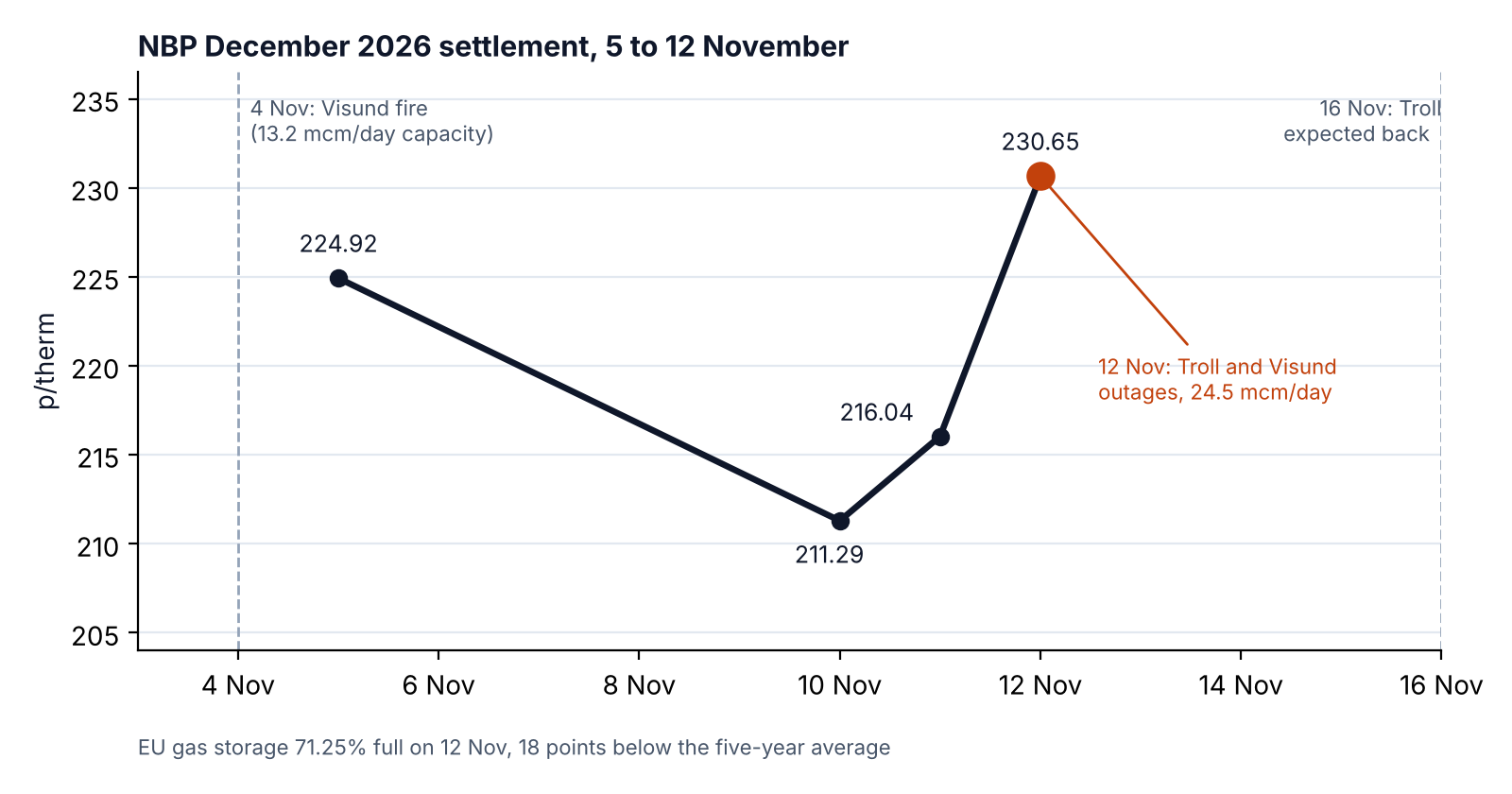
A fire in an electrical switchgear room on the Visund platform on 4 November took about 13.2 mcm/day of export capacity offline, roughly 3.7% of Norway’s total. The platform was shut down and depressurised. The fire was put out; 128 people were on board at the time, and no injuries were reported. The operator is preparing repairs; no cause has been published, and the Norwegian offshore safety authority has opened an investigation, which usually ends in a public report.
Other work added to the loss. By Thursday, Troll and Visund together were removing 24.5 mcm/day, which implies Troll accounted for roughly 11.3 mcm/day, after Åsgard maintenance had cut a further 6.5 mcm/day on Wednesday. Shelf output has since recovered to 327.7 mcm/day. Troll is expected back on 16 November, the same date listed for Visund, though both dates are subject to revision.
Norway matters for UK buyers because it supplies a large share of Britain’s imported gas by pipeline, so even short outages can move the prompt price. This week showed how quickly that happens: NBP day-ahead rose 25.40p on Thursday alone, from 207.00p on Wednesday, on supply losses, a colder forecast and Middle East headlines. Brent rose 3.3% to $95.82 that day after unconfirmed claims of attacks on Saudi oil sites and tankers near Hormuz, and finished Friday at $95.84/bbl, about 2.5% below the previous Friday.
LNG fills part of the gap
UK LNG sendout rose from about 47 mcm/day on Wednesday to close to 60 mcm/day on Thursday, with five tankers inbound. North-west Europe’s December LNG price was $28.90/MMBtu, and JKM rose 6.38% to $30.50/MMBtu. That leaves the Asian premium at about $1.60/MMBtu, which is thin enough that cargoes have little reason to divert away from Europe.
Cargoes into north-west Europe have been mostly US-origin, and the first Qatari cargo since April is expected to arrive via a Polish terminal. The forward curve adds a further signal. On Tuesday, Summer 27 was trading above Winter 27, which points to competition for injection volume next year more than to scarcity this winter. Put together, LNG is helping to meet demand now, but it is not yet rebuilding stocks.
Power and carbon follow gas
UK day-ahead baseload power settled at £183.00/MWh on Thursday, up £5.99 on the day, with December 2026 baseload at £196.84/MWh. Gas is setting the price in many hours, so what happens to gas supply feeds straight through to power. Carbon was steadier: EUA December ended at €90.38/t and UKA December at £66.94/t.
Temperatures were forecast to fall well below seasonal norms from 13 November, with a second colder spell and weaker wind expected in the week of 16 November before conditions normalise around 22 November. Colder, calmer weather raises gas burn for heating and for power at the same time.
What this means for buyers
Low storage means the market can react sharply to any supply loss or cold forecast, even when flows have largely recovered. Buyers should expect headline-driven moves in the prompt and front-month contracts, and should check how any fixed quote reflects the current winter curve.
Three practical points follow. Fixed-price offers for winter are tracking the December and first-quarter contracts, so a quote can change within a single session and the period it is held for matters. Buyers on flexible or pass-through contracts carry the most exposure to prompt volatility, and those approaching renewal should ask what a quote is based on and how long it stays open. Buyers with daytime-weighted demand should also look at power, where winter peak premiums are wide.
A confirmed Troll return and steady LNG arrivals would ease pressure, while delays to restarts or a long cold spell would add to it. Either outcome could arrive within days, so the direction of the next move is not clear.
What to watch
• Monday 16 November: scheduled end of the Troll outage and the listed date for Visund, both subject to revision.
• Weekly storage data: whether withdrawals slow once temperatures normalise around 22 November.
• LNG arrivals: the five tankers inbound to the UK, and the Qatari cargo in Europe.
• Any published cause or timetable from the Visund investigation.
• Friday 27 November: a 14-day Torness outage begins, ending on 11 December, adding to winter gas burn for power.
The Energy Ledger
This newsletter is for information only and does not constitute financial or procurement advice.