

It has been a volatile week for UK energy markets. NBP day-ahead gas started the week at 129.50p/therm on 6 August, dipped to a low of 136.25p on 10 August, then jumped sharply to 146.65p on 11 August as concerns over Middle East supply security reasserted themselves. By this morning, prompt gas had eased slightly to 145.00p, still up close to 12% on the week.
The swing tells you most of what you need to know about where this market’s attention is right now. It isn’t really about UK fundamentals. Storage is filling, Norwegian flows are steady enough, and LNG cargoes keep landing on schedule at Gate, Eemshaven and the rest. What’s moving prices is the Strait of Hormuz, and specifically whether Washington and Tehran can turn five months of intermittent conflict into something that actually reopens the waterway.
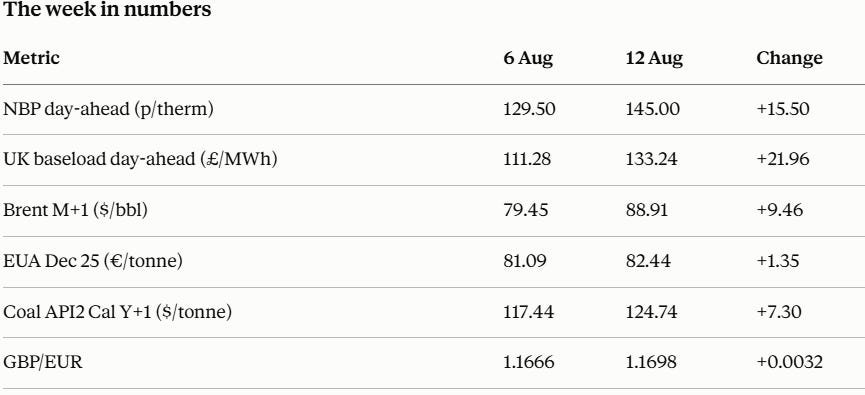
Power tracked gas higher across the week. UK day-ahead baseload climbed from £111.28/MWh to £133.24/MWh. Brent had the sharpest run of the lot, up almost $9.50 a barrel as shipping through Hormuz thinned out again.
Storage still lagging, but the trend is right
EU gas storage moved from around 58% full on 4 August to just under 59% by 9 August, according to GIE data cited in the broker notes. That’s roughly 12 percentage points below where the bloc sat this time last year. Germany and the Netherlands remain particularly underfilled, sitting below 50% and 40%. Injection rates have been running around 18% behind last year’s pace.
UK storage tells a similar story. Rough remains offline at zero, Humbly Grove is still empty, and the more meaningful UK gas sites (Aldbrough, Holehouse Farm, Hornsea and Stublach) sit in the high 30s to high 60s percent range. South Hook’s LNG storage has been one of the standout movers, climbing from 41% on 6 August to a peak of 79% on 7 August before settling back into the 70s.
The read from TotalEnergies’ desk this week is that Europe may struggle to get much beyond 70-75% storage before winter without a sustained pickup in LNG imports. That’s well short of the bloc’s 90% flexible target for 1 October to 1 December.
Hormuz: hopes raised, then dashed
The week’s real story played out in the Gulf. Monday through Wednesday brought genuine optimism. Iran signalled it was nearing a final agreement with Oman on new shipping lanes through the Strait, and traders started pricing in a partial reopening. That optimism didn’t last. By Tuesday this week, both the US and Yemen’s Houthis had reported separate attacks on shipping, and President Trump responded to Iran’s conditions for a peace deal by demanding compensation for those killed in the conflict. The standoff hardened rather than eased.
Vessel movements through the Strait have been the clearest barometer. They fell to just six on Monday, against a 10-day average of around 11, and TTF front-month gas spiked almost 10% in a single session on 11 August. Congressional Research Service data this week confirmed what the daily flows have been showing all along: periodic Iranian attacks and retaliatory US strikes have disrupted Strait traffic for most of the past five months. The current calm looks more like both sides running out of steam than any real resolution. Roughly a fifth of global LNG supply normally transits Hormuz, so every flare-up shows up almost immediately in European forward curves.
Supply side: Norway steady, LNG arrivals holding up
Norwegian Continental Shelf exit nominations bounced around a fairly narrow band this week, from the low 310s up to 325.5 mcm/day this morning, with planned maintenance at Vesterled and the Ormen Lange field trimming capacity at the margins. Gassco extended the partial Ormen Lange outage through to 1 February 2027. It barely moved the daily numbers, but it quietly takes some winter flexibility off the table.
LNG arrivals into North West Europe have stayed busy: a steady flow of US cargoes into Gate, Eemshaven and Fos, plus occasional deliveries from Norway, Algeria and, notably, Russia (a 103,000 cmc cargo booked into Gate for 15 August). UK LNG sendout has held close to 8 mcm/day for most of the week.
Weather has added to demand too. The UK has moved through a run of heatwave conditions, with forecasts peaking in the low-to-mid 20s°C around 12-13 August. Gas-for-power demand has climbed as a result, even with wind output generally sitting below seasonal norms.
What to watch
Iran-Oman talks: any concrete progress on Strait shipping lane rules would likely pull risk premium back out of Winter-26 gas and power contracts quickly. Equally, a fresh escalation could push NBP through 150p.
French and Belgian nuclear availability: heat-related outages have been building, with French nuclear reductions expected to peak around 10.7 GW this week, partly driven by a jellyfish influx affecting cooling intake at coastal stations.
EU storage trajectory into September: watch whether injection rates start closing the gap on last year’s pace, or whether the 70-75% ceiling becomes the market’s working assumption for winter entry.
UK temperatures: EC46 forecasts have been revising toward a cooler second half of next week, which should ease gas-for-power demand from current heatwave-driven highs.
If you found this useful, please consider sharing it with a colleague who trades, procures or just wants a clearer read on where UK gas and power are headed.