


Campaigners told the London Assembly that fast growth in data centres could push thousands of households into fuel poverty. The figures are projections, the headline water number is a worst case, and the grid pressure behind the story is already real.
London’s data centre building boom came under scrutiny last week at a London Assembly environment committee hearing. Witnesses warned that the extra demand on energy and water could land on households. London already has 99 data centres and accounts for more than 80% of the UK’s data centre capacity. Another 26 are planned or moving through the system.
The fuel poverty claim
Oliver Hayes, head of campaigns at the environmental group Global Action Plan, told the committee that high-growth projections for data centres could push about 77,000 households across Britain into fuel poverty through higher energy bills. About 10,000 of those would be in London. He described the London figure as early analysis at a regional level.
The group’s research also suggests that added demand from new data centres could add an average of £88 to a household energy bill. The reports of the hearing do not say whether that is an annual or one-off amount, or what assumptions sit behind it. Both numbers come from a campaign group’s scenarios for future demand growth. They are not forecasts from a regulator or a statutory body.
How big is the demand?
The system operator gives a sense of the scale behind those scenarios. In written evidence to a parliamentary inquiry, NESO said its current analysis points to around 5.2GW of connected data centre capacity and just over 20TWh of annual demand by 2030. It also said that connection requests now exceed 70GW, with a shift towards very large sites connected directly to the transmission network.
Not all of that will be built. The Energy Secretary has said that future demand from data centres remains inherently uncertain, and the gap between requests and likely delivery is one reason forecasts vary so widely. The government has also set up AI Growth Zones, which are designed to speed up planning and access to power for AI infrastructure.
The grid pressure is already visible in West London
The grid pressure is not hypothetical in one part of the capital. Since 2022, areas in West London, including Hillingdon, Hounslow and Ealing, have been at full electricity grid capacity, which temporarily halted new housing developments. A London Assembly planning committee report in December 2025 named data centre expansion as a contributing factor and recommended a separate planning use class for data centres.
The Greater London Authority worked with the network companies and Ofgem on short-term fixes, and more than 12,000 homes had been connected by early 2025. Wider upgrades are expected by 2037. City Hall’s own figures say London needs 880,000 new homes over the next decade as well as more data centres, which is why the two demands are meeting at the same substations. Some industry commentators argue that part of the blockage is capacity that has been reserved but may never be used, rather than genuine demand.
The water claim
Jon Chappell, deputy director of Water UK, told the committee that water systems are built to cope with peak demand. Extra summer demand from data centres would raise that peak, which means larger service reservoirs and treatment works. He added that parts of the east and south-east of England already cannot build homes or expand businesses because of water shortages.
The 77 million litres a day figure that appeared in headlines comes from a specific scenario. If every future data centre used as much water as the least efficient existing one, England would need an extra 77 million litres a day, roughly the use of three London boroughs. That is a worst case for England as a whole, not a measured figure for London.
Rory Murphy, a research associate at the University of Exeter, pointed to US data showing that data centres used 66 billion litres of water directly for cooling in a year and around 800 billion litres indirectly through electricity generation. The reports do not name the study, and US conditions are not directly comparable with the UK.
What the water evidence shows
The UK evidence is thinner. Environment Agency research using metered data from around 200 data centres for 2024 to 2025 found a clear summer peak in water demand from the sector. That supports the point about peak demand, though not the size of the scenario above.
The industry has pointed to its own survey. A report from the trade body techUK, drawing on a survey with the Environment Agency covering 73 sites in England, found that 51% of the data centres surveyed use waterless cooling. Campaigners have criticised the report, arguing that its self-reported data may give a misleading picture. Both sides agree that more reliable, metered data would help.
What the Mayor and others said
The Mayor of London has said he commissioned a study on what new data centres mean for London’s water supply. He has noted that the impact varies with the cooling technology used, and that City Hall is looking at water and grid effects, including household water demand in hot summers. He has called for a proper comprehensive plan for London. The findings of the study have not been reported.
The draft London Plan supports data centres in suitable locations in principle, but only where there is enough electricity and water capacity. Zack Polanski, the Green Party leader and an Assembly Member, called for a slowdown in new data centre construction, citing bills, emissions and the housing emergency. Coverage of the hearing includes no response from data centre operators.
Why this matters beyond London
Data centres cluster in London because of its closeness to the City and because new facilities tend to be built near existing ones. That concentration is what makes grid and water capacity a local planning question as well as a national one. Any developer looking for a site in the capital is competing with housing and other users for the same electricity connections and water supply.
For businesses, the practical point is that connection timing is becoming a planning risk in its own right. A site that cannot secure a grid connection for years is a different proposition from one that can.
What to watch
The findings of the Mayor’s water study, when they are published.
Whether Global Action Plan publishes the modelling behind the 77,000 and £88 figures.
How the final London Plan words the requirement for electricity and water capacity.
Whether the government acts on the recommendation for a separate planning use class for data centres.
Whether data centre operators respond to the claims.
Market Watch
UK gas and power fell sharply on Monday as easing US-Iran tensions, warmer forecasts and weaker Asian LNG buying reduced both risk and heating demand. NBP day-ahead settled at 206.00p/th, down 18.90p (8.4%) on Friday, and the December contract fell 15.90p to 211.11p/th. The front of the curve moved most, with Summer 2027 down 8.27p to 155.01p/th. Supply helped: Norwegian exit nominations rose to 330.8 mcm/d, Troll maintenance has ended and the Jackdaw field began producing for the UK.
Power followed gas lower. Day-ahead baseload settled at £173.00/MWh, down £13.00, helped by higher wind output and French imports of 1.7GW, their highest since late August after the IFA interconnector returned to full capacity. Brent fell $3.40 to $92.44 a barrel, and carbon eased, with EUAs down €0.88 to €87.27/t and UK ETS down 60p to £64.42/t.
Prices firmed slightly early on Tuesday. NBP day-ahead was indicated at 210.95p/th and day-ahead baseload at £179.50/MWh, with wind expected to fall sharply and gas-for-power demand forecast to rise by 16 mcm/d. Oil was lower again despite continued attacks in the Strait of Hormuz.
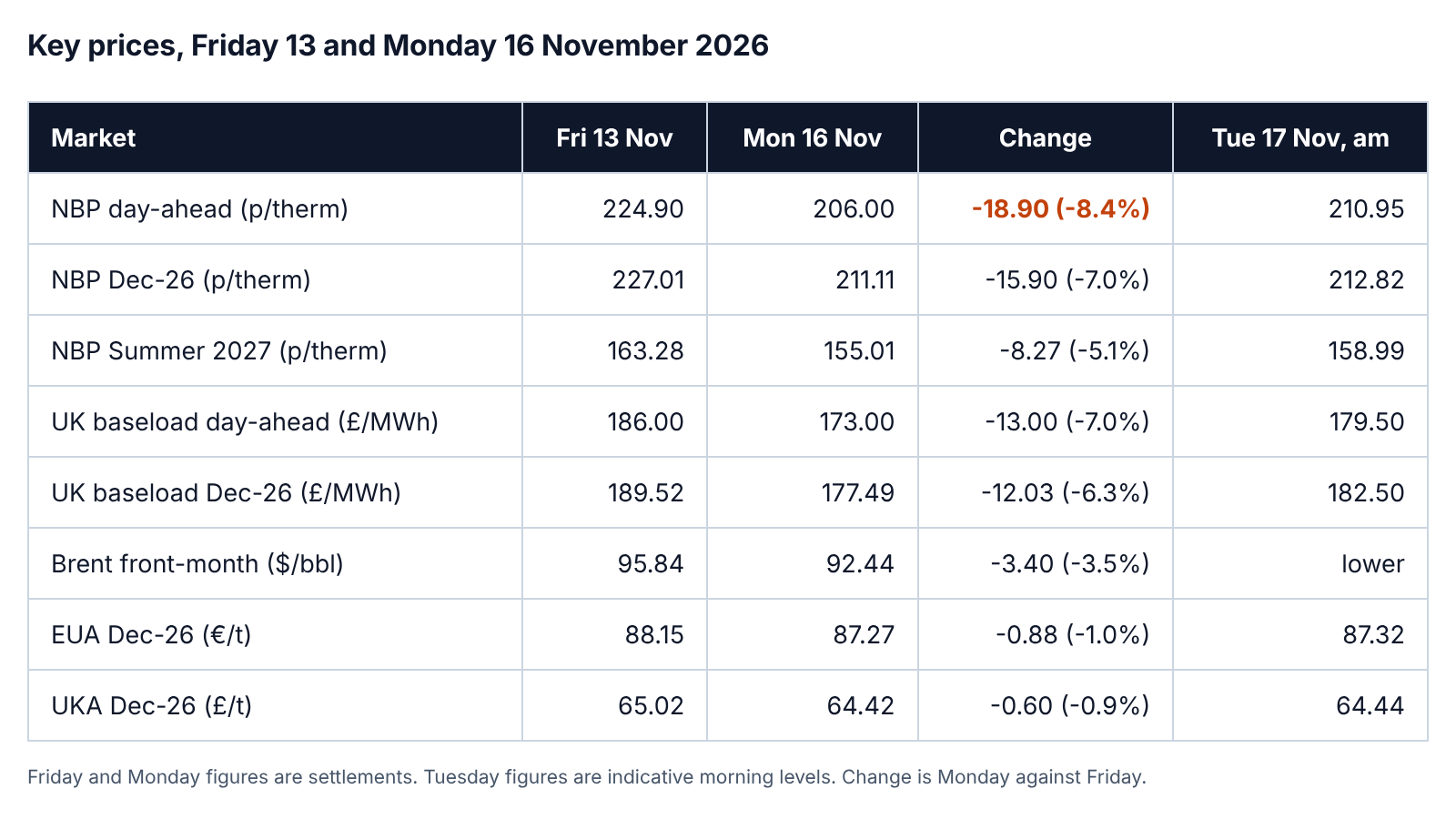
Monday and Friday figures are settlements. Tuesday figures are indicative morning levels and will move during the day.
The Energy Ledger
This newsletter is for information only and does not constitute financial or procurement advice.